
Sobrasada: how Mallorca’s soft paprika sausage is made
Meat, pork fat, pebre bord and plenty of patience: how soft sobrasada is made on Mallorca, what the matança means and how to store the sausage.
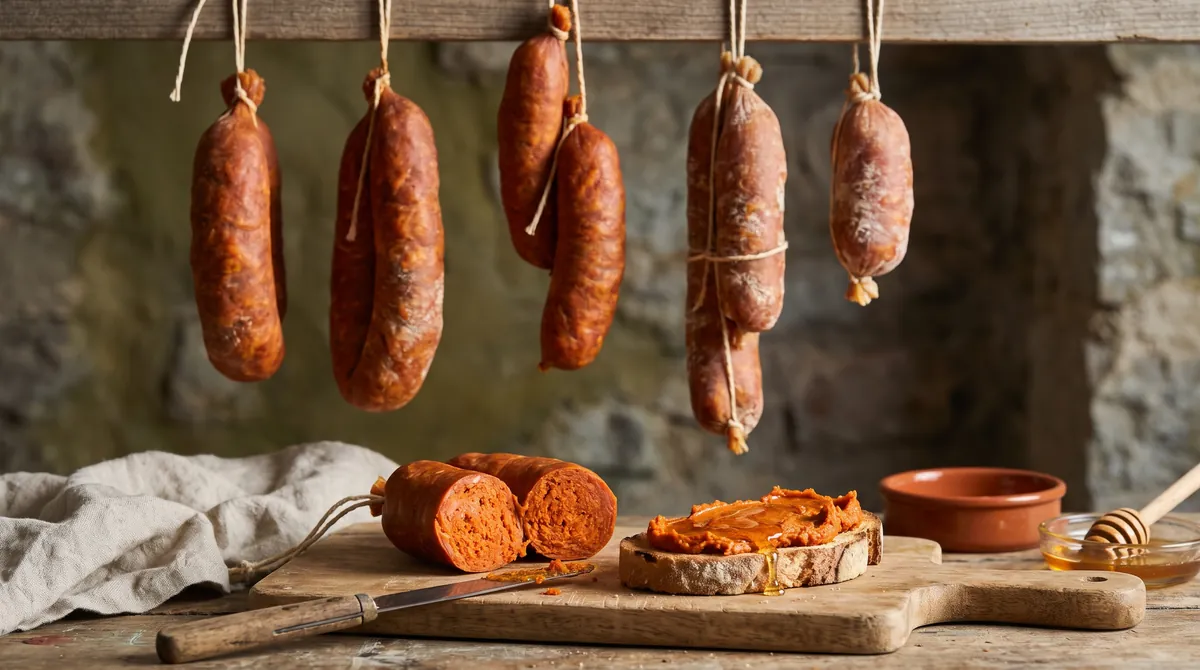
When you step into a room where sobrasada is maturing, the first thing you smell is paprika: sweet, warm, almost fruity. Then comes the scent of cured meat, gently tangy and savoury. The sausages hang close together on poles, small and thin, large and round, all in a deep red-orange that almost glows in the dim light. The air is cool, and the island’s humidity drifts in through an open window. This is where sobrasada matures, the soft paprika sausage that on Mallorca belongs to breakfast, to a snack with bread and to many festivities.
What makes a sobrasada
Sobrasada de Mallorca, Sobrassada de Mallorca in Catalan, is a PGI, a protected geographical indication. It refers to a raw-cured, spreadable sausage made from pork and pork fat, seasoned with paprika, salt and spices. Unlike a firm salami, it stays soft. Usually you do not slice it but spread it on bread.
On Mallorca the paprika is called pebre bord. It can be sweet or hot, and it gives the sausage its colour. Together with the salt, it also helps the sobrasada keep and stops its fat from turning rancid too quickly. That is why the mixture is a deep red even before it goes into the casing, and the red holds throughout the maturing.
White pig, black pig
Most sobrasadas are made with meat from white pigs. A special variety comes from the black Mallorcan pig, the porc negre mallorquí. This native breed lives outdoors, and its sobrasada is considered especially aromatic. It is labelled as such. If you get the chance, taste it side by side with a sobrasada from white pigs: only in a direct comparison do you notice how differently two sausages made to the same basic recipe can taste.
Mincing, kneading, filling
Production begins with choosing the meat and the fat. Both are finely minced until a smooth, soft mixture forms. Then pebre bord, salt and spices are added and the mixture is kneaded thoroughly, in the past by hand in large bowls, today often by machine as well. Kneading spreads the spices and binds the mixture until it is supple and evenly red throughout.
It is filled into natural casings. On Mallorca the different shapes have their own names. The llonganissa is a long, thin sausage, while the bisbe is a large, round shape that takes correspondingly longer to mature. After filling, the sausages are tied off, often with string, and hung up to mature.
- finely mince the meat and pork fat
- knead thoroughly with pebre bord, salt and spices
- fill the mixture into natural casings
- tie off the sausages
- hang them in a cool, airy place
- leave to mature for weeks to months, depending on size
Sobrasada is not only made, it is waited for: meat, paprika and salt need time to become a soft, rounded sausage.
Maturing in the island climate
After filling, the sausages hang in cool, airy places. Now the slow maturing begins, during which the sausage loses water and develops its aroma, yet stays soft. The humid island climate plays its part: the air does not dry the sausage out as quickly as a dry inland climate would, so the maturing proceeds at a leisurely pace. Depending on size, it takes weeks to months. A thin llonganissa is ready much sooner than a large, round bisbe.
Experienced makers judge how far along a sausage is with their eyes, nose and fingers: how does it feel, how does it smell, how even is the colour? A good sobrasada is evenly red inside, soft, slightly glossy with fat, and smells of paprika, neither sharp nor musty.
The matança: sausage making as a winter festival
Long before there were cold stores, sausage making was a job for the cold months. At the matança, the winter pig slaughter on the farms, usually between November and February, the family came together to process a pig. The cold helped to get meat and sausages safely into the maturing. There was mincing, seasoning, kneading and filling, and at the end the provisions for many months were hanging up. The matança was work and celebration at once, with many hands, shared meals and long conversations.
On some farms and in some families the tradition lives on. If you are on Mallorca in winter and get invited, it is a sign of trust. A pig slaughter is not a show for guests but family work, and that is the best way to approach it: with respect, curiosity and a willingness to lend a hand if they let you.
Sobrasada in the kitchen
The classic could not be simpler: spread sobrasada on toasted bread and add a thread of honey. The sweetness balances the spice of the paprika, and the fat melts on the warm bread. Warmed briefly in the oven, the sausage turns soft and smells even stronger. It goes with fried eggs, it gives sauces colour and depth, and on coca, the Mallorcan flatbread baked on a tray, it is a much-loved topping.
Sobrasada melts quickly in the heat. So warm it only briefly and gently, otherwise the fat runs out and the paprika can turn bitter. Peel off the skin before using it.
Storing and buying
Hang a whole sobrasada somewhere cool and dry, just as it matured. Once it is cut, cover the cut surface, for example with greaseproof paper or film, and keep it cool, in the fridge in summer. That way it does not dry out or take on other smells. Because sobrasada is raw-cured, it is one of the foods to discuss with your doctor first if you are pregnant.
At the market or directly from the maker, it is worth asking a few questions:
- Is the meat from white or black Mallorcan pigs?
- Is the sobrasada mild or hot?
- How long has this sausage matured?
- Is it filled into a natural casing?
- How should I best store it at home?
Goes well with
- toasted bread
- honey
- fried egg
- coca
- potatoes
- tomato sauce
The dish to go with it
recipe
Toasted bread with sobrasada and honey
The Mallorcan classic: warm sobrasada on toasted bread with a thread of mild honey.
Ingredients
Method
- Take the sobrasada out of the fridge half an hour beforehand and peel off the skin.
- Preheat the oven to 200 °C (conventional oven).
- Drizzle the slices of bread with a little olive oil and toast them in a frying pan until golden brown on both sides.
- Spread the sobrasada evenly over the still warm bread.
- Put the bread in the oven for 2 to 3 minutes, until the sobrasada is glossy and starting to melt.
- Drizzle over the honey, scatter a few crystals of flor de sal on top if you like and serve straight away.
Note: With hot sobrasada the contrast with the honey is especially striking.
Questions and answers
Does sobrasada need cooking?
No, sobrasada is raw-cured and is usually spread on bread just as it is. You can warm it briefly in the oven or a pan, though, which makes it soft and more fragrant. Heat it only gently, as it melts quickly.
Do you eat the skin of sobrasada?
No, the natural casing is peeled off before use. With a sausage you have already cut, peel off only as much skin as you need at the time; the rest protects the sausage.
Is sobrasada spicy?
That depends on the kind. There is mild sobrasada made with sweet pebre bord, and there are hot versions. Ask when you buy if you are unsure.
What is the matança?
The matança is the traditional winter pig slaughter on Mallorcan farms, usually between November and February. Families process a pig together and make sausages such as sobrasada to keep.
Further reading in our network
- island mallorcaThe island atlas
The island atlas of Mallorca, with villages, beaches and walks, and the Mallorca away from the coast.
Our articles are general information written with care. Harvest times, rules and offers change; if in doubt ask the producer or retailer. For allergies and intolerances, the ingredient list on the pack is what counts.